
Feb. 12, 2026 – Florida-based Lennar Corp. agreed to pay nearly $2.7 million in exchange for “incidental taking” of otherwise federally protected endangered species in developing the controversial Guajolote Ranch in northwest Bexar County, as approved in a December meeting of a regional conservation committee.
The arrangement became effective Feb. 3, just hours before heavy earth-movers began leveling vast portions of Guajolote Ranch, destroying heritage oaks and other sensitive features. While the agreement is accepted as a form of mitigation, the net effect is that Lennar will be allowed to disturb, harm or even kill off some habitat and endangered species while engaging in development deemed “lawful.”
The land-clearing, coming on the eve of breeding season for the federally protected golden-cheeked warbler, is giving fresh fuel to opponents – and with a district court review of Lennar’s wastewater permit for the project looming plus plans to re-engage with San Antonio City Council following its unanimous rejection on Feb. 5 of a municipal utility district for the development.
The agreement that paved the way passed swiftly and with little discussion by the Southern Edwards Plateau Habitat Conservation Plan Coordinating Committee on Dec. 9, billed as a joint effort by the city of San Antonio and Bexar County “to balance the conservation needs of rare plants and animals with the demand for economic growth and development.”
The committee’s “mitigation determination” that recommended approval of the plan relied upon an on-site habitat determination conducted between July and September 2025 by “permitted biologist” Pape-Dawson Consulting Engineers LLC – whose directors include top executives of Pape-Dawson Engineers Inc., Lennar’s paid engineer for the Guajolote Ranch development.
See the approved plan, here: https://www.scenicloop.org/wp-content/uploads/mini-packet_Southern-Edwards-Plateau-Habitat-Conservation-Plan-Coordinating-Comm-2.pdf
“Our concern continues to grow as city, county, and state commissions and departments approve Guajolote Ranch requests despite clear opposition from residents and many elected officials who recognize the project’s negative impact on our community,” said Emory Bluhm, president of the Scenic Loop-Helotes Creek Alliance. “These continued approvals risk creating a public perception of a disconnect between city and county leadership and the staffs implementing these decisions.”
See a new video from the alliance, here: https://www.youtube.com/watch?v=_0a9X2sabCM.
Under the permit, good for a year, applicant Lennar Homes of Texas Inc. agreed to pay $2.68 million to purchase “preservation credits” plus other fees in exchange for limited incidental taking of federally listed endangered species on 229.7 acres of the total 1,160-acre development.
A taking is defined by the federal Endangered Species Act of 1972 as an action to “harass, harm, pursue, hunt, shoot, wound, kill, trap, capture or collect, or to attempt to engage in any such conduct.” Lennar has stated plans to build 2,900 homes at the site, west of the intersection of Scenic Loop and Babcock roads.
Pape-Dawson’s on-site habitat determination, accepted by the SEP-HCP committee, identified 132.5 acres of federally protected golden-cheek warbler habitat in the project area, plus another 80.9 acres within 300 feet of it. The determination was conducted at the site after the bird’s breeding season had ended last June, and when it already had begun its migration south to Mexico.
The survey did not turn up any habitat for the endangered black-capped vireo. And while the project area is located over two karst zones totaling 248.6 acres, no “critical habitat units” were identified for endangered karst invertebrates, referring to cave-dwelling species, nor was it determined to be within 750 feet of an “occupied feature.” Several caves are known to be on adjacent properties.
The payment breakdown included a golden-cheeked warbler conservation credits fee of $2,416,880; a karst zone participation fee on 17.6 acres of $17,620; and a plan administration fee of $243,450. The city’s Development Services Department staff recommended approval of the plan. Such fees typically go into a mitigation bank for protection of species elsewhere. Alternatively, Lennar could have elected to consult directly with the U.S. Fish and Wildlife Department for Endangered Species Act compliance.
A participation agreement Feb. 3 formalizing the deal identified the participants as landowners Guajolote Ranch Inc. of Terrell Hills, represented by treasurer Richard H. “Rick” LePere, and Sidney E. “Gene” Edwards Jr. and wife Marcie, of Palm Beach Gardens, Florida. Lennar has held options to purchase the land for their development from those landowners, who were the same ones who filed for the unsuccessful MUD on behalf of the developer.
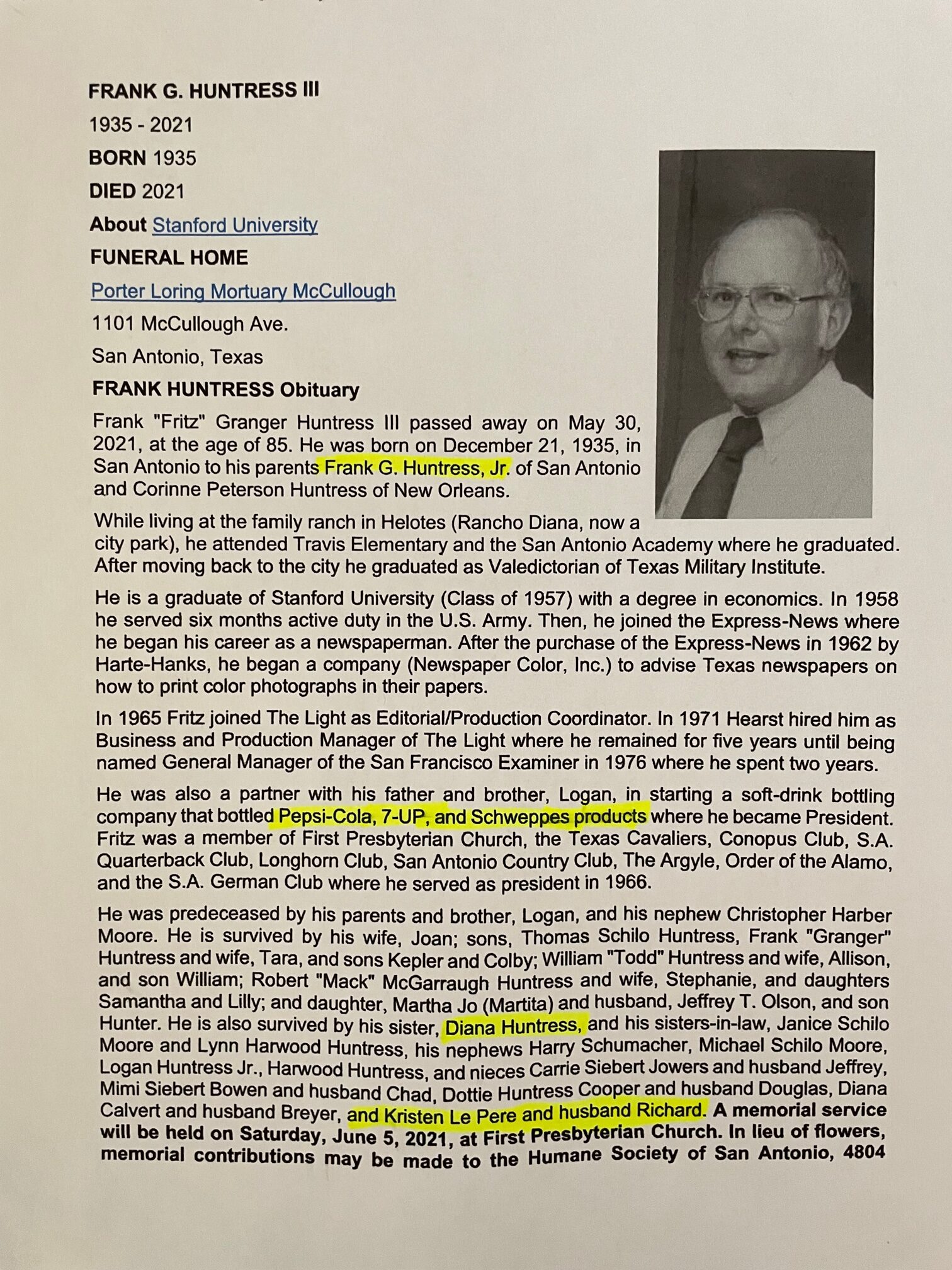
LePere and his family have held approximately 1,097 acres of Guajolote Ranch, with the Edwardses holding about 63 acres that would provide access to the development off of Scenic Loop Road. LePere is a grandson-in-law of family patriarch Frank G. Huntress Jr., who established Guajolote Ranch in 1969.
So far, deed records don’t show that the land since has passed to Lennar, although John Bare, a land development manager for Lennar, told a neighbor of the development that the Edwards tract had sold two weeks ago.

Participants in the agreement were defined as “the owner of a leasehold interest in or is affiliated with the owner of the (subject) tract or tracts.” LePere signed the participation agreement on Jan. 28, and the Edwardses on Jan. 30. Nicole Salinas, interim administrator of the city of San Antonio’s Development Services Department, signed the agreement on behalf of the city on Feb. 3.
There was no mention of the agreement at the city council meeting two days later when the MUD was voted down, and where the MUD applicants still were being identified as Guajolote Ranch Inc. and the Edwardses.
Notably, during the city council’s deliberations on the MUD application, Development Services reported that Lennar had declined to sign a proposed development agreement in conjunction with the application that was aimed at further environmental protections.
The project would release an average of 1 million gallons a day of treated sewage into the Helotes Creek watershed, which directly recharges the Trinity Glen Rose Aquifer, the water supply for the immediate area, and contributes up to 15% of the total recharge of the Edwards Aquifer, principal water source for about 2.5 million people across multiple counties.
The Scenic Loop-Helotes Creek Alliance is a nonpartisan, nonprofit 501(c)(3) group representing the largest neighborhood by square mile recognized by the San Antonio Neighborhood & Housing Services Department, a wide corridor along Scenic Loop Road from Bandera Road to north of Babcock Road.
Scenic Loop-Helotes Creek Alliance contacts:
Randy Neumann, SL-HCA steering committee chair, 210-867-2826, uhit@aol.com
Steve Lee, 210-415-2402, text; media@scenicloop.org